Hydroxyzine for the prevention of pruritus and nausea vomiting from spinal morphine in patients having transabdominal hysterectomy under combined spinal-general anesthesia: A randomized control trial
Department of Anesthesiology, Department of Obstetrics and Gynecology, Faculty of Medicine Siriraj Hospital, Mahidol University, Bangkok 10700, Thailand.
Download:
Abstract
Background: Pruritus and nausea vomiting are common side effects of spinal morphine and general anesthesia. Hydroxyzine is one of the antihistamines that are used for treating pruritic and nauseous patients. A randomized prospective double-blind study was undertaken in order to identify the preventive effects of hydroxyzine to prevent pruritus and nausea vomiting in patients who have transabdominal hysterectomy under combined spinal-general anesthesia. Methods: 80 patients scheduled for elective transabdominal hysterectomy under combined spinal-general anesthesia were randomized to receive either hydroxyzine 75 mg and oral midazolam 7.5 mg (atarax or ATR group) or placebo and oral midazolam 7.5 mg (control or C group) as premedication at least half an hour before their operation. Clinical data (vital signs, pruritic score, nauseous score, sedation score, etcetera) were recorded at pre-operative, intraoperative and 48-hour post-operative periods. All patients had spinal block with 0.5% heavy bupivacaine 2 ml with 0.3 mg preservative free morphine and general anesthesia with thiopenthal sodium 5 mg/kg as induction, intubated with atracurium 0.6 mg/kg and maintenance with nitrous oxide in 50% oxygen and isoflurane. A conventional reversal technique was done in all patients. Intravenous fentanyl was used for pain as needed, oral chropheniramine syrup 2 tsp (4 mg/10 ml) every 4 hours was used for pruritus and intravenous ondanzetron (8 mg) was used for nausea/vomiting in the post-operative period. Results: Pruritus and nausea vomiting were observed blindly 24 and 48 hours post-operation. At 24 hours post-operation, there were 5 patients in the ATR group (12.5%) and 6 patients in the control group (15%) who had mild pruritus. There was no significant difference between the two groups (p = 0.745). At 48 hours post-operation, all patients were free of pruritus. There were 2 patients who had mild nausea (5%) and 2 patients who had moderate nausea (5%) in the control group within 24 hours post-operation. In the ATR group there was no patient who had mild or moderate nausea. There was no significant difference between the two groups (p = 0.152). At 48 hours post-operation, there was 1 patient in each group who had mild nausea (2.5%), which had no significant difference. At 24 and 48 hours post-operation, all patients were free of vomiting. Conclusion: Hydroxyzine cannot prevent pruritus and nausea/vomiting from spinal morphine in patients having transabdominal hysterectomy under combined spinal-general anesthesia.
Intrathecal or spinal morphine is one of the techniques used for reducing pain in the postoperative period. Its common side effects are pruritus and nausea or vomiting.1 The incidence of pruritus is about 66% and nausea/vomiting is 43%.2 Although the mechanism is unclear, one hypothesis concerns 5HT3 receptor stimulation.3 Pruritus and nausea/vomiting remain common side effects of general anesthesia too. The incident is variable due to various causes. The explanation is multi-factorial, such as deriving from side effects of multiple drugs used in general anesthesia or from gastric blow up during the induction phase. Transabdominal hysterectomy (TAH) is a procedure that can be performed under many types of anesthesia, while combined spinal-general anesthesia is a common technique for anesthetizing patients especially in cases of huge myoma uteri, TAH with lymph node dissection and suspected malignancy. Thus these patients might be troubled by the common side effects, pruritus and nausea/vomiting.
Hydroxyzine is one of the antihistamines that antagonize the H1 receptor, and its effects are reducing pruritus, nausea/vomiting, and the mild effect of sedation.4 With these effects Hydroxyzine is widely used for treating pruritic and nauseous patients, but the use of it for prevention of these symptoms is unfamiliar.
There have been several studies about Hydroxyzine that is used in the peri-operative period. One used 75 mg oral Hydroxyzine as an anxiolytic drug for premedication5 and one used Hydroxyzine for prevention of nausea and vomiting in patients who have cesarean section.7 There has been few studies about Hydroxyzine used as a preventive drug for nausea and vomiting in patients who have TAH.
The aim of this study is to prove the preventive effect of oral Hydroxyzine in postoperative pruritus and nausea/vomiting in patients who have TAH under combined spinal-general anesthesia. (The goal is 50% reduction in pruritus and nausea/vomiting symptoms of the patients).
MATERIALS AND METHODS
After Siriraj Ethical Committee approval, a prospective randomized control trial was conducted. The patients who were scheduled for TAH and met the criteria, including ASA (American Society of Anesthesiologists) classification 1-2, age from 18-60 years old, body mass index (BMI) below 35 and who accepted combined spinal-general anesthesia as the choice of anesthesia for TAH and intrathecal morphine as post-operative pain control, were enrolled. The patients who had any previous history of Hydroxyzine allergy or had urticaria, pruritus, nausea vomiting or motion sickness as underlying diseases or complications from a previous procedure or anesthesia were excluded. The patients who had drugs that effected pruritus and nausea vomiting or who had epidural morphine for post-operative pain control were also excluded.
From previous studies, the incidence of post-operative pruritus are from 25% to 85%, (mean is 60%).1,2,3,4,9,12,13,14,15 If Hydroxyzine can decrease the incident of pruritus by 50%, the target incident is 30%. We calculated the number of patients per group by this formula, N = [2(zα + zb)2P(1-P)]/(pc-pt).2 We indicated that pc = 0.6, pt = 0.3, P = (0.6 + 0.3)/2 = 0.45, zα = 1.65 and zb = 0.84. After that we added 10% to the result for compensation for the patients who quit this study, finally we had 40 patients per group.
Eighty patients were randomized by the program Research Randomizer from www.randomozer.org/form.htm to receive either oral hydroxyzine 75 mg (3 tabs of 25 mg Hydroxyzine) and oral midazolam 7.5 mg (1/2 tab of 15 mg midazolam) (ATR group) or placebo (3 tabs of starch that mimic Hydroxyzine and oral midazolam 7.5 mg (C group) from a coated envelope as premedication at least half an hour before their operations. The observers and evaluators never knew the groups of patients. This could prevent the bias from scoring data and evaluating the results. In the operative room the sedation score was evaluated. Ringer’s Lactate was administered, 15 ml/kg intravenous within 30 minutes, then 150 ml/hour continuously until the operation was completed. Non-invasive blood pressure (NBP), pulse oximetry and electrocardiogram (ECG) were monitored in all patients. Spinal block with 0.5% heavy bupivacaine 2 ml with 0.3 mg preservative free morphine was performed by a number 25 Whitacre’s spinal needle and the injection rate was 2 ml in 20 seconds. General anesthesia was performed by thiopenthal sodium 5 mg/kg as induction, intubated with atracurium 0.6 mg/kg and maintained with nitrous oxide in 50% oxygen and isoflurane as needed. NBP was recorded every minute for 15 minutes, then every 2 minutes for 30 minutes and then every 5 minutes until the completion of the operation. If systolic blood pressure was below 110 mmHg with heart rate below 90 beats per minute, 6 mg of ephedrine was intravenously administered to patients and if the heart rate was above 90 beats per minute, 4 μg of levophedR was intravenously administered to patients. A conventional reversal technique with 1.2 mg atropine and 2.5 mg prostigmine was performed in all patients. After extubation patients were sent to the recovery room where vital signs, pruritic score, nauseous score, and sedation score were recorded until patients were sent to the ward. At the ward, vital signs, pruritic score, nauseous score and sedation score were recorded until 48 hours post-operation. Intravenous fentanyl was used for pain as needed, oral chropheniramine syrup 2 tsp (4 mg/10 ml) every 4 hours was used for pruritus and intravenous ondanzetron (8 mg) was used for nausea vomiting in the post-operative period. The amounts of these supplemental drugs were recorded too.
Statistical analysis The data were processed using SPSS for Windows (Statistical Package for the Social Science) version 13.0. Ordinary data such as age and BMI were analyzed by mean and standard deviation. The differences in pruritic score, nauseous score, sedation score and other complications were analyzed by Chi-Square. The P value of < 0.05 was considered statistically significant.
RESULTS
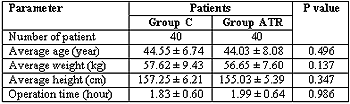
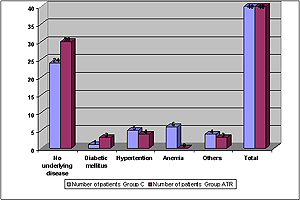
A total of 80 patients’data were evaluated. The demographic data of the patients are shown in Table 1 and the number of patients who had underlying diseases are shown in Table 2. There was no statistically significant difference in average age, weight, height and operation duration between the 2 groups of patients. (P value > 0.05)
There were 4 common underlying diseases in this study, diabetic mellitus (DM), hypertension (HNT), anemia and others such as thyroid disease. All of the patients who had underlying disease had only one underlying disease. There were no smoking or ex-smoking patients in this study.
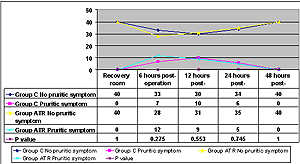
Pruritic score was recorded by number, 0 = no symptom, 1 = mild symptom and no need for medical treatment, 2 = mild symptom and needed medical treatment, 3 = moderate symptom and relief by medical treatment, 4 = moderate symptom and no relief through medical treatment, 5 = severe symptom and relief through medical treatment and 6 = severe symptom and no relief through medical treatment. From this score we defined 0 = negative for pruritic symptom and 1-6 = positive for pruritic symptom. We evaluated at the recovery room after operation and anesthesia finishing time as baseline, then at 6, 12, 24, 48 hours post-operation as shown in Table 3. There was no patient who had pruritic symptoms in the recovery room after operation and after anesthesia was finished and 48 hours post-operation. There were 7 patients in group C and 12 patients in group ATR who had pruritic symptoms at 6 hours post-operation. There were 10 patients in group C and 9 patients in group ATR had pruritic symptoms at 12 hours post-operation. There were 6 patients in group C and 5 patients in group ATR had pruritic symptoms at 24 hours post-operation. There was no statistical significant difference between the 2 groups during the entire evaluated period. (P value > 0.05)
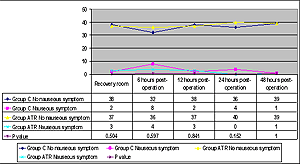
Nauseous score was recorded as a number: 0 = no symptom, 1 = mild symptom, 2 = moderate symptom, 3 = severe symptom and 4 = vomiting symptom present. From this score we defined 0 as negative for nauseous symptom, 1-4 as positive for nauseous symptom. We evaluated the patients at the recovery room after the operations and when anesthesia finished as the baseline, then at 6, 12, 24, 48 hours post-operation as shown in Table 4. There were 2 patients in group C (1 with mild symptom and 1 with moderate symptom) and 3 patients in group ATR (2 with mild symptom and 1 vomiting) had nauseous symptom at recovery room after the operation and the anesthesia was stopped. There were 8 patients in group C (3 with mild symptom, 2 with moderate symptom, 2 with severe symptoms and 1 vomiting) and 4 patients in group ATR (2 with mild symptoms, 1 with severe symptom and 1 vomiting) had nauseous symptom at 6 hours post-operation. There were 2 patients in group C (1 with mild symptom and 1 with moderate symptom) and 3 patients in group ATR (2 with mild symptoms and 1 with moderate symptom) had nauseous symptom at 12 hours post-operation. There were 4 patients in group C (2 with mild symptoms and 2 with moderate symptoms) but no patient in the ATR group had nauseous symptom at 24 hours post-operation. There was 1 patient in each group (1 with mild symptom) had nauseous symptom at 48 hours post-operation. There was no statistically significant difference between the 2 groups during the entire evaluation period. (P value > 0.05)
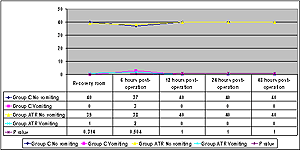
Vomiting data was collected in parallel with nauseous symptom and shown in Table 5. There was 1 patient in the ATR group who had vomiting symptom at the recovery room after the operation and anesthesia finished. There were 3 patients in group C and 2 patients in the ATR group who had vomiting symptoms at 6 hours post-operation. However, there was no statistically significant difference between the 2 groups. (P value > 0.05) After 12 hours post-operation there was no patient who had vomiting symptom.
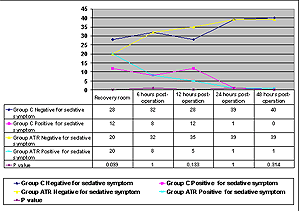
The sedation score was recorded as a number: 0 = eye opening, 1 = mild ptosis, 2 = response to command, 3 = easy to arouse, 4 = response to strong stimuli, 5 = deep sleep. From this score we defined 0 = negative for sedative symptom and 1-5 = positive for sedative symptom that may need treatment. We evaluated at the recovery room after the operation and when anesthesia was finished as a baseline then at 6, 12, 24, 48 hours post-operation as shown in Table 6. There were 12 patients in group C and 20 patients in the ATR group who had sedative symptoms at the recovery room after the operation and anesthesia finished. There were 8 patients in each group who had sedative symptoms at 6 hours post-operation. There were 12 patients in group C and 5 patients in the ATR group who had sedative symptoms at 12 hours post-operation. There was 1 patient in each group who had sedative symptoms at 24 hours post-operation. There was 1 patient in group ATR who had sedative symptom at 48 hours post-operation. There was no statistically significant difference between the 2 groups all through the evaluated period. (P value > 0.05)
Table 1. Demographic data.
Table 2. The patients’ underlying diseases.
Table 3. Pruritic data at recovery room after the operation and the anesthesia finished, 6, 12, 24, 48 hours post-operation shown in number of patients and percent.
Table 4. Nauseous data at recovery room after the operation and the anesthesia finished, 6, 12, 24, 48 hours post-operation shown in number of patients and percent.
Table 5. Vomiting data at recovery room after the operation and the anesthesia finished, 6, 12, 24, 48 hours post-operation shown in number of patients and percent.
Table 6. Sedative data at recovery room after the operation and the anesthesia finished, 6, 12, 24, 48 hours post-operation shown in number of patients and percent.
DISCUSSION
This study was designed to identify the preventive effect of Hydroxyzine as a premedicant for pruritus and nausea vomiting from spinal (Intrathecal) morphine in patients who had TAH under combined spinal and general anesthesia.
The comparison of the two groups revealed no difference in the percentage of patients who suffered from side effects of spinal morphine: pruritus, nausea, vomiting, and sedation, at all evaluated times, at the recovery room after the operation and when anesthesia finished until 48 hours post-operation.
There were many previous studies which revealed that the side effects of spinal morphine, pruritus, nausea and vomiting, could be prevented by other drugs. For example Michael et al., reported that pre-operative gabapentin prevented pruritus induced by spinal morphine in patients undergoing lower limb surgery under spinal anesthesia.6 Somrat et al., reported that nalbuphine and ondansetron were more effective than placebo for the prevention of intrathecal morphine induced pruritus after cesarean delivery.7 Christos et al., and Heui-Ming et al., similarly reported that ondansetron had a preventive effect for spinal morphine induced pruritus.8,9 However, there was no previous study about Hydroxyzine or other antihistamines for the prevention of intrathecal morphine induced pruritus or nausea and vomiting in TAH patients.
Hydroxyzine is a first-generation antihistamine, that is an H1 receptor antagonist. It is used primarily as an antihistamine for the treatment of itches and irritations, as an antiemetic for the reduction of nausea, as an effective sedative, hypnotic, and tranquilizer. Maybe this is the reason why our result reported that no difference in the percentage of patients who suffered from side effects of spinal morphine, pruritus, nausea, vomiting, and sedation, at all evaluated time between both groups. Hydroxyzine was more beneficial in treatment than prevention.
Although Hydroxyzine has effective sedative, hypnotic, and tranquilizer properties our study reported no difference in the percentage of patients who had sedative symptoms at any of the evaluated times between both groups. Shapira et al., studied Hydroxyzine as a premedicant for sedation of pediatric dental patients and proved that the combination of Hydroxyzine (3.7 mg/kg) with midazolam (0.3 mg/kg) administered 30 minutes before treatment resulted in safe and effective sedation for the dental treatment of young children.10 This effect was not observed in our study because we used 75 mg Hydroxyzine (1-1.5 mg/kg) and at this dose the sedative symptom was not different between the 2 groups which is similar to Boon et al., who reported that Hydroxyzine 1-2 mg/kg premedication provided no better anxiolytic effect than a placebo.11
Hydroxyzine’s half-life is around 7-10 hours in adults. Our study administered 75 mg Hydroxyzine one time before the operation as a premedicant and the evaluated time was longer than its half-life without any additive dose of Hydroxyzine, so that at 6 or 12 hours post-operation all effects of Hydroxyzine had dissipated. The side effects of intrathecal morphine were dominant as in the general population and the result revealed no difference between the 2 groups.
Our study had several limitations. First, pruritus, nausea and vomiting are subjective sensations and individual variations in pruritus, nausea and vomiting are wide. There is no tool to record the symptom precisely. Second, at the first evaluated time, at the recovery room after the operation and anesthesia had finished, there were many patients who had sedative symptoms and at that time other symptoms were observed and recorded, too. Thus perhaps we missed some important data from the still sedated patients.
CONCLUSION
In summary, 75 mg oral Hydroxyzine as a premedicant can not prevent pruritus and nausea/vomiting from spinal morphine in patients having transabdominal hysterectomy under combined spinal-general anesthesia.
ACKNOWLEDGMENTS
The present study was supported by the Research Development Fund, Faculty of Medicine Siriraj Hospital, Mahidol University. We wish to thanks Assoc. Prof. Thitima Chinachoti for her assistance in the statistical analysis.
References
1.
Raffaeli W, Marconi G, Fanelli G, Taddei S, Borghi GB, Casati A. Opioid – related side- effects after intrathecal morphine: a prospective randomized, double blind dose – response study. Eur J Anaesthesiol. 2006 Jul;23(7):605-10.
2.
Latrou CA, Dragoumanis CK, Vogiatzaki TD, Vretzakis GI, Simopoulos CE, Dimitriou VK. Prophylactic intravenous ondansetron and dolasetron in intrathecal morphine induced pruritus: a randomized double blinded, placebo controlled study. Anesth Analg. 2005 Nov;101(5):1516-20.
3.
Ko MC, Lee H, Song MS. Activation of kappa-opioid receptors inhibits pruritus evoked by subcutaneous or intrathecal administration of morphine in monkeys. J Pharmacol Exp Ther. 2003 Apr;305(1):173-9.
4.
Horta ML, Morejon LCL, da Cruz AW. Study of the prophylactic effect of droperidol, alzapride, propofol, and promethazine on spinal morphine induced pruritus. Br J Anaesth. 2006 Jun;96(6):796-800.
5.
Franssen C, Hans P, Brichant JF, Noirot D, Lamy M. Comparison between alprazolam and hydroxyzine for oral premedication. Can J Anaesth. 1993 Jan;40(1):13-7.
6.
Michael JS, Shung-Tai H, Chian-Her L. Preoperative gabapentin prevents Intrathecal morphine induced pruritus after orthopedic surgery. Anesth Analg. 2008 Jun;106(6):1868-72.
7.
Somrat C, Oranuch K, Wanna S. Nalbuphine versus ondansetron for prevention of Intrathecal morphine induced pruritus after cesarean delivery. Anesth Analg. 2003 Jun;96(6):1789-93.
8.
Christos AI, Christos KD, Theodosia DV. Prophylactic intravenous ondansetron and dolasetron in Intrathecal morphine induced pruritus: a randomized double blinded placebo controlled study. Anesth Analg. 2005 Nov;101(5):1516-20.
9.
Heui-Ming Y, Li-Kuei C, Chen-Jung L. Prophylactic intravenous ondansetron reduces the incident of Intrathecal morphine induced pruritus in patients undergoing cesarean delivery. Anesth Analg. 2000 Jul;91(1):172-5.
10.
Shapira J, Kupietzky A, Kadari A. Comparison of oral midazolam with and without hydroxyzine in the sedation of pediatric dental patients. Pediatr Dent. 2004 Nov-Dec;26(6):492-6.
11.
Boon JH, Hopkins D. Hydroxyzine premedication, does it provide better anxiolysis than placebo? S Afr Med J. 1996 Jun;86(6):661-4.
12.
Luthiman JA, Kay NH, White JB. Intrathecal morphine for post cesarean sction analgesia: does naloxone reduce the incidence of pruritus? Int J Obstet Anesth. 1992 Sep;1(4):191-4.
13.
Sarvela PJ, Halonen PM, Soikkeli AI, Kainu JP, Korttila KT. Ondansetron and tropisetron do not prevent intraspinal morphine- and fentanyl-induced pruritus in elective cesarean delivery. Acta Anaesthesiol Scand. 2006 Feb;50(2):239-44.
14.
Szarvas S, Chellapuri RS, Harmon DC, Owens J, Murphy D, Shorten GD. A comparison of dexamethasone, ondansetron, and dexamethasone plus ondansetron as prophylactic antiemetic and antipruritic therapy in patients receiving intrathecal morphine for major orthopedic surgery. Anesth Analg. 2003 Jul;97(1):259-63.
15.
Slappendel R, Weber EW, Benraad B, van Limbeek J, Dirksen R. Itching after intrathecal morphine. Incidence and treatment. Eur J Anaesthesiol. 2000 Oct;17(10):616-21.




















 Copyright © 2005-2008 Siriraj Medical Journal